
When a tooth has to
come out.
Dealing with a damaged or painful tooth? We always aim to save your natural teeth — but when one can’t be saved, a gentle extraction protects the rest of your mouth. Dr. Bradley, a UCLA-trained, surgically-proficient dentist, evaluates every tooth carefully and keeps the visit comfortable.
- UCLA-trained dental surgeon
- Implants placed & restored in-house
- Most insurance accepted
- Monthly payment plans
- Se habla español
- Award-winning · West LA Dental Society
Removing a tooth that can’t be saved.
A tooth extraction is a procedure where the dentist carefully removes a tooth from its socket in the jawbone. The area is fully numbed with local anesthetic so the experience stays comfortable. It becomes the right choice when other treatments can’t resolve the problem — usually severe decay, advanced gum disease, a tooth broken beyond repair, or crowding that affects your oral health.
What a careful extraction does for you.
Ends the pain
Removing a badly damaged or infected tooth relieves the ache and pressure that no other treatment could fix.
Stops infection spreading
Taking out an infected or abscessed tooth keeps the bacteria from reaching the bone and the healthy teeth around it.
Protects your smile
Clearing a hopeless or crowded tooth makes room for proper alignment and a clear plan to replace what’s missing.
Signs a tooth may need to come out.
Severe damage or decay
When a tooth is too far gone from decay, trauma, or infection, extraction may be the best way to stop the problem from spreading.
Overcrowding
If teeth are severely crowded or misaligned, removing one can create the space needed for proper alignment during orthodontic treatment.
Risk of infection
An infection or abscess near a tooth — often from advanced decay or gum disease — may need extraction to stop the bacteria and protect your health.
Impacted wisdom teeth
Wisdom teeth that can’t emerge properly can cause pain and swelling. Removing them helps prevent future dental problems.
Every step kept smooth and comfortable.
Exam & X-ray
We assess the tooth with a digital X-ray to confirm whether removal is truly the best option.
Treatment plan
We walk you through a personalized plan — what the procedure involves, your insurance, and monthly payment options — so there are no surprises.
Extraction day
We numb the area fully, gently remove the tooth, and control any bleeding for a smooth start to healing.
Aftercare & replacing the tooth
You get clear healing instructions, plus options to fill the gap — an implant, bridge, or partial denture — so neighboring teeth don’t shift.
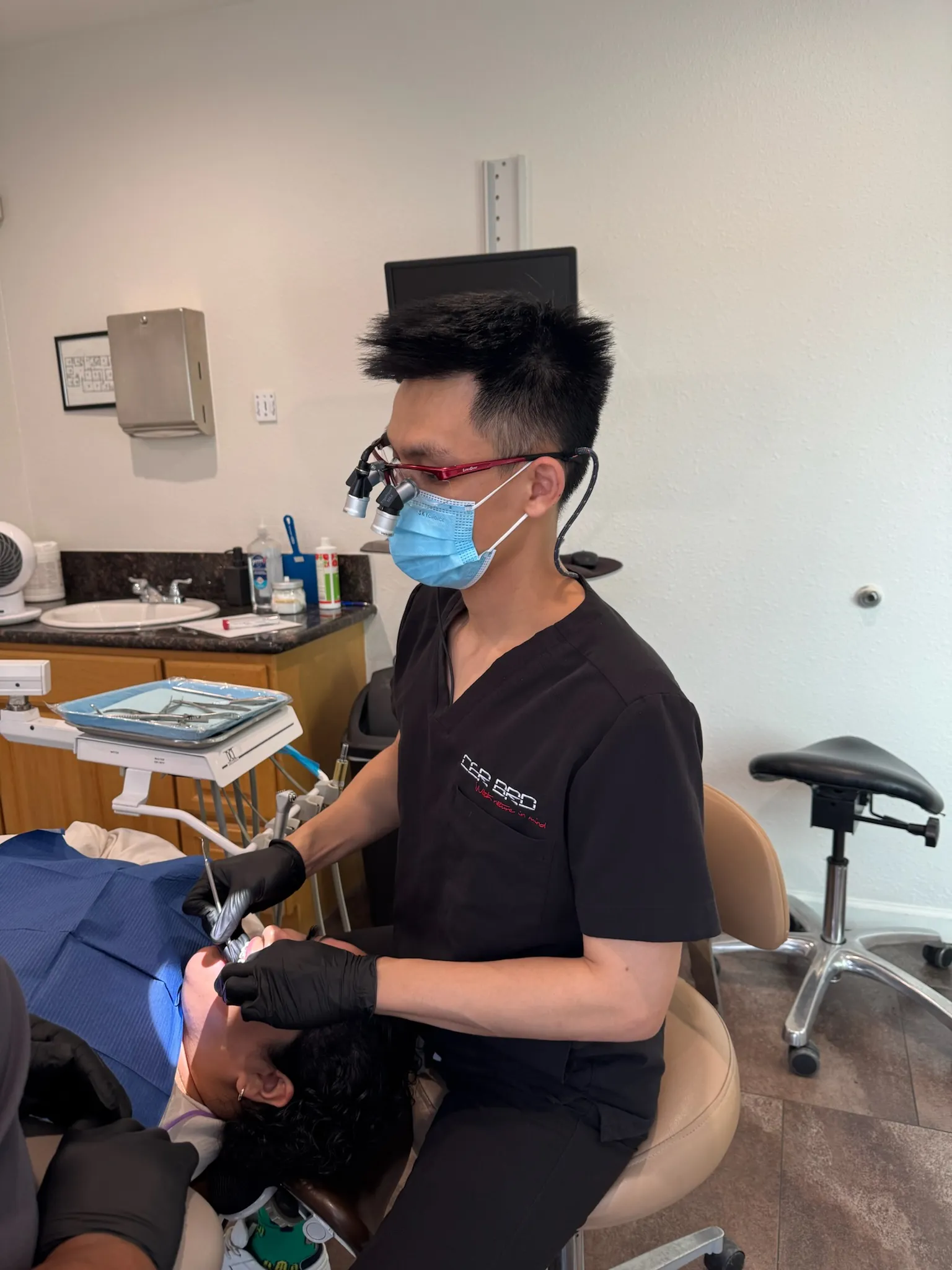
Planned and performed in one place.
Dr. Bradley is a UCLA-trained, surgically-proficient dentist who plans, places, and restores your treatment himself — so the dentist who knows your mouth is the one doing the work, start to finish.
Surgically trained dentist
Four UCLA degrees and a decade of education and training, plus advanced surgical and implant fellowships and a faculty appointment at the UCLA School of Dentistry.
Everything under one roof
Surgery, implants, and restorations handled in-house — no being referred across town.
Affordable, explained up front
Most major insurance accepted and monthly payment plans available, reviewed with you up front.
Trusted by Huntington Park families
“Dr. Bradley really cares for your teeth — his philosophy is to keep as much of the natural tooth as possible. He explained everything clearly, calmed my nerves, and did the procedure perfectly.”
“The best dentist in town. They really helped me with my fillings — completely pain-free — and made me feel at home through the whole process. Highly recommend.”
“My oral health has improved a lot with Dr. Bradley. He listens to my concerns and explains exactly what he’s doing and why — he even shows me the X-rays. He handles my cleanings and put on my adult braces himself, and the whole team is stellar.”
Tooth extraction questions, answered.
Does it hurt to have a tooth pulled?
We take every precaution to keep you comfortable. The area is numbed fully, so most patients feel little to nothing during the procedure itself. Some mild soreness during recovery is normal and settles quickly.
How much does a tooth extraction cost?
It depends on the tooth and how involved the removal is — a simple extraction differs from a surgical one. We keep it clear and within reach: most major dental plans help cover extractions, especially when they’re medically necessary, and we offer monthly payment plans. We also accept Medi-Cal Dental (Denti-Cal), for adults and children. We verify your benefits and go over your exact number at your appointment — no surprises.
How long does it take to recover?
Most people feel back to normal within a few days. The socket typically closes over one to two weeks, with the bone underneath healing over several more. Resting the first day and avoiding straws and smoking helps you heal faster.
When can I eat normally after an extraction?
Stick to soft foods for the first day or two — soup, yogurt, eggs, smoothies (no straws) — and chew on the opposite side. Most people work back to their normal diet within a few days to a week as the area heals, avoiding anything crunchy, spicy, or very hot at first. We’ll give you a simple day-by-day guide.
What is dry socket?
Dry socket happens when the protective blood clot over the healing site comes loose too early, exposing the bone and causing pain a few days later. Avoiding straws, smoking, and vigorous rinsing lowers your risk — and if pain worsens, we can treat the area and get you comfortable again.
Reviewed by Dr. Bradley Salvatore, DDS · Updated July 1, 2026
Explore related care.
Oral Surgery
Most general offices send surgery out. Dr. Bradley trained specifically for it — so the dentist who knows your mouth is the one doing the work, and planning what comes next.
Explore →Wisdom Teeth Removal
Wisdom teeth, also called third molars, are the last set of teeth to develop. Because the jaw often doesn’t have enough space for them, they can become impacted — stuck below the gum — which leads to pain, infection, and other problems. Removing them before they cause trouble helps you avoid future complications and keeps your smile healthy.
Explore →Bone & Sinus Grafting
When teeth are lost, the jawbone underneath slowly shrinks — which can make implants harder to place and change the shape of your face. A bone graft adds natural or synthetic bone material to that area to encourage new growth and rebuild strength. A sinus lift is a related procedure for the upper back jaw: it gently raises the sinus membrane and places bone beneath it, where the molars and premolars sit, when the sinus cavity has left too little bone for an implant.
Explore →
In pain? Let us take a look.
Most major insurance accepted · monthly payment plans available.
We’re closed right now — book online in seconds and we’ll confirm your appointment.